
Finding skincare that balances real results with sensible spending can feel like a constant challenge, especially for women juggling busy lives and changing skin needs. The truth is, choosing affordable products does not mean settling for less. Dermatologists confirm that well formulated affordable skincare delivers the same clinically proven ingredients as expensive counterparts. This article breaks down the myths around luxury price tags, clarifies the benefits of science backed routines, and helps you discover how affordable skincare can simplify your routine while keeping your skin healthy and radiant.
Table of Contents
- Defining Affordable Skincare And Common Myths
- Key Ingredients And Hybrid Beauty Innovations
- How Affordable Formulations Deliver Results
- Financial Impact Of Value-Driven Routines
- Comparing Effectiveness And Risks To Alternatives
Key Takeaways
| Point | Details |
|---|---|
| Affordable Skincare Equals Quality | Affordable products can perform just as well as luxury counterparts due to clinically proven ingredients without the markup from branding. |
| Ingredient Transparency is Key | Always check ingredient lists and active concentrations to ensure you are getting effective treatment for your skin. |
| Hybrid Products Enhance Efficiency | Skincare-infused makeup reduces routine complexity while delivering active ingredients effectively. |
| Financial Benefits are Significant | Switching to an affordable skincare routine can save you up to £1,800 annually while maintaining skin health. |
Defining Affordable Skincare and Common Myths
Affordable skincare isn’t a compromise on quality or efficacy. It’s a category of products formulated with clinically proven active ingredients that deliver measurable results without the inflated markup that comes with prestige branding. The key distinction separates what you’re actually paying for (the formula) from what you’re subsidizing (luxury marketing, packaging, and brand heritage). When dermatologists assess skincare, they evaluate ingredient concentration, formulation stability, and clinical evidence of efficacy. Price point doesn’t factor into that evaluation. A £24 serum containing 10% niacinamide performs identically to a £79 alternative with the same concentration. Your skin doesn’t recognize the brand name on the bottle.
The myth that expensive products always deliver superior results persists because marketing budgets are excellent at creating perception. When you see a prestige brand’s £85 moisturizer, much of that cost reflects advertising spend, luxury retail partnerships, and brand prestige rather than ingredient quality or research advancement. Common skincare myths debunked by dermatologists clarify that well-formulated affordable products deliver the same clinically effective ingredients like retinoids and ceramides as their luxury counterparts. You’re not sacrificing science by choosing a lower price point. In fact, many women find that expensive products underdeliver because they prioritize aesthetic experience (luxurious textures, fragrance, jarring ritual) over actual skin impact. This creates a false association between price and performance that benefits retailers far more than your skin.
Another widespread misconception suggests that natural ingredients are inherently safer or more effective than synthesized ones. Your skin doesn’t distinguish between a naturally derived peptide and a lab-created one if they’re chemically identical. What matters is whether the ingredient has clinical evidence supporting its efficacy and whether it’s formulated at an effective concentration. Affordable skincare can absolutely contain science backed actives. The difference lies in how those formulations reach you. By partnering strategically with manufacturers and filling unused production capacity rather than building premium retail experiences, affordable brands pass ingredient costs directly to consumers instead of embedding them in overhead. This model means you get the same treatment power without funding a flagship store in Mayfair.
Here’s what separates affordable skincare from genuinely inferior products: transparent ingredient lists, published concentrations of active compounds, and clear clinical evidence of what each ingredient does. You should be able to identify exactly why a serum costs £24 versus £79. If you can’t, you’re likely paying for branding rather than science. Many women over 35 have spent years on luxury routines that promised transformation but delivered only tired skin and a lighter wallet. Switching to affordable skincare backed by actual ingredient science often feels revelatory because the expectation shifts from “this should work because it costs more” to “this works because it contains proven actives at effective concentrations.”
Pro tip: Before purchasing any skincare product, check the ingredient list for your target actives (retinol, niacinamide, hyaluronic acid, peptides) and their position in the list. If your active ingredient appears after fragrance or water, it’s likely underdosed regardless of price point.
Key Ingredients and Hybrid Beauty Innovations
The skincare aisle has transformed dramatically over the past five years, and it’s not because premium brands invented something new. It’s because affordable formulations now access the same breakthrough ingredients that once justified £150 price tags. Peptides, niacinamide, hyaluronic acid, and antioxidants are the workhorses of modern skincare. These aren’t exotic or rare. They’re reproducible, well-studied, and increasingly available in affordable products at clinically effective concentrations. A peptide is a peptide whether it costs £30 or £120. Your skin responds to the molecule itself, not the marketing story attached to it. The real innovation isn’t discovering new ingredients anymore. It’s making proven ones accessible at prices that don’t require you to choose between skincare and groceries.
Breakthrough skincare ingredients like antioxidants and peptides contribute to skin health through multiple mechanisms, offering anti-inflammatory benefits and supporting your skin barrier. Niacinamide reduces sebum production and strengthens the barrier function, making it particularly valuable for women over 35 dealing with combination skin or sensitivity. Hyaluronic acid holds up to 1000 times its weight in water, plumping skin from within. Peptides signal your skin to produce more collagen and elastin, addressing the exact changes your skin undergoes during hormonal shifts. None of these ingredients require exclusivity pricing. They require only proper formulation, appropriate concentrations, and honest ingredient lists. This is where affordable skincare excels and luxury brands often fail.
Then hybrid beauty arrived and changed the entire game. Rather than applying serum, waiting for absorption, then layering foundation that offers nothing but coverage, hybrid products embed skincare actives directly into makeup formulations. Imagine a tinted moisturizer that contains 4% niacinamide plus SPF 50 protection, delivering treatment, coverage, and sun defense simultaneously. This isn’t a gimmick. This is efficiency meeting science. Skincare-infused makeup products combine peptides and antioxidants with cosmetic benefits, meaning every application works on two fronts. You’re not choosing between looking polished today or investing in tomorrow’s skin. You’re achieving both in one step. For women managing aging skin without time for elaborate routines, this shift feels revolutionary. A five-step routine becomes three steps. Three steps becomes one multifunctional product. Your morning takes eight minutes instead of twenty, and your skin receives the same clinical actives it would from a luxury line costing three times as much.
The hybrid approach specifically addresses why affordable skincare succeeds where traditional luxury skincare sometimes stalls. A £79 moisturizer with impressive packaging might contain modest concentrations of active ingredients because substantial budget went to sourcing, packaging, and retail partnerships. A £24 hybrid cream from an affordable brand eliminates those intermediaries. That cost difference translates directly into ingredient investment. Your £24 product contains the same peptide concentration as a £79 alternative, plus SPF protection and tinted coverage the luxury option doesn’t offer. You’re not sacrificing efficacy by choosing affordable hybrid products. You’re gaining functionality while maintaining science-backed formulations. This represents a genuine departure from the traditional “you pay for quality” model that benefits retailers far more than your skin.
Pro tip: Look for products listing peptides, niacinamide, or hyaluronic acid in the top five ingredients, then check the concentration percentage if available. Products listing these actives after water or glycerin are likely underdosed regardless of whether they’re affordable or expensive.
How Affordable Formulations Deliver Results
The reason affordable skincare works isn’t mysterious or complicated. It comes down to formulation science. A well-designed product doesn’t need luxury pricing to be effective. What it needs is precision in how ingredients are combined, stabilized, and delivered to your skin. Advanced formulation techniques enhance ingredient bioavailability and skin penetration, enabling active components to reach the layers of skin where they actually work. This isn’t happening in exclusive laboratories at premium brands. It’s happening in facilities worldwide where formulation chemists understand pH balance, emulsion stability, and molecular delivery. Affordable brands access the same formulation expertise as luxury ones. The difference is overhead. When a £24 serum contains the same peptide concentration as a £89 alternative, the gap exists in marketing spend and retail markup, not in the chemistry itself.
Understand how formulations actually function and the affordability question disappears. Consider niacinamide, a proven ingredient for barrier repair and sebum regulation. Its effectiveness depends on concentration (typically 4-10%), pH environment (ideally 4.5-6.5), and whether the formula keeps it stable through its shelf life. A prestige brand at £85 might invest heavily in luxurious texture and fragrance, leaving less budget for optimal niacinamide concentration. An affordable formulation strips away the aesthetic extras and concentrates resources on the active ingredient itself. Your skin doesn’t taste the formula or appreciate the packaging. It absorbs the niacinamide molecule and responds accordingly. The formulation’s job is simply to get that molecule to your skin in stable, effective condition. Affordable brands excel at this unglamorous but essential task.

Delivery mechanisms matter far more than price point. Encapsulation technology protects delicate ingredients like retinol and vitamin C from degrading during storage, allowing them to reach your skin potent and effective. Emulsion systems keep water and oil phases properly balanced so hydrating and nourishing ingredients distribute evenly across your skin. pH buffering ensures active ingredients work at their optimal pH rather than being neutralized by an overly alkaline formula. These aren’t expensive techniques exclusive to prestige laboratories. They’re standard formulation practices available to any manufacturer prioritizing efficacy over aesthetics. An affordable serum with proper encapsulation delivers retinol more effectively than a £120 luxury option with poor stability. You could literally apply the affordable version and see better results because the ingredient actually reaches your skin instead of degrading in the bottle.
Here’s where affordable skincare genuinely outperforms luxury alternatives. Prestige brands often rely on perceived efficacy. The ritual feels luxurious. The packaging photographs beautifully. The scent suggests sophistication. But if you strip away those sensory elements, what remains is the formula itself. Many women over 35 have spent years on luxury routines that promised transformation but delivered subtle, uncertain results. Switching to an affordable, efficacy-focused formulation often feels revelatory because expectations shift from “this should work because it costs more” to “this is working because I can see visible changes in four weeks.” Your skin doesn’t care about luxury. It responds to active ingredients delivered at effective concentrations in stable formulations. Affordable brands understand this clearly. They’ve eliminated everything except what actually matters. This focused approach, combined with strategic manufacturing partnerships that reduce overhead, means you get clinical efficacy at prices that feel genuinely affordable.
Pro tip: Check the product’s pH level if available (usually 4.5 to 6.5 is optimal for most actives), and look for stabilizing ingredients like Vitamin E or ferulic acid near the active ingredient in the ingredient list, indicating the formula was designed to maintain potency.
Financial Impact of Value-Driven Routines
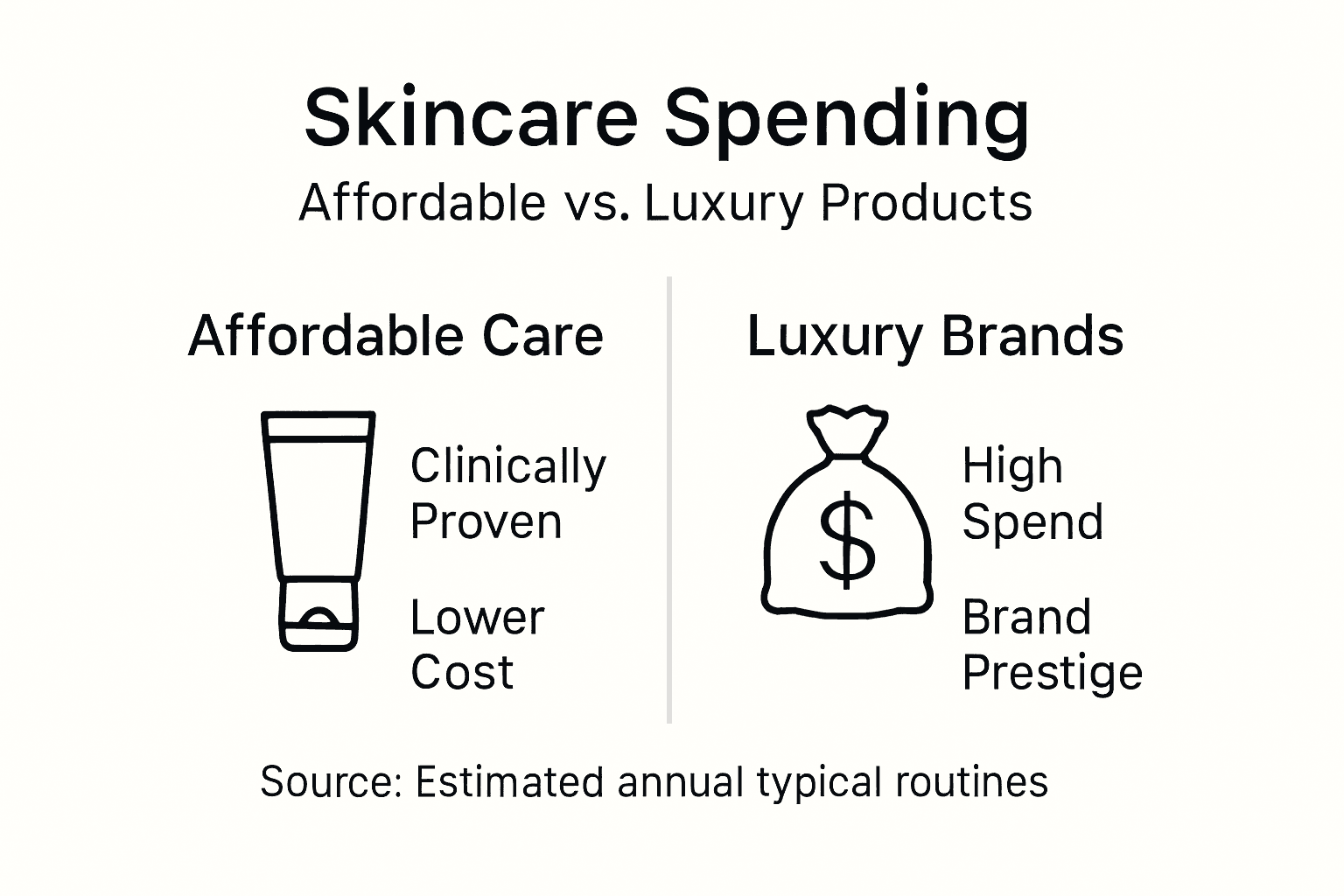
The math on skincare spending is straightforward, yet most women never actually calculate it. A luxury skincare routine for women over 35 typically includes a cleanser (£35-45), a treatment serum (£65-95), a day moisturizer (£55-75), an eye cream (£45-65), and an SPF product (£40-60). Total annual investment before any special treatments: roughly £800-1,200 per year. This assumes purchasing one of each product annually, which grossly underestimates reality since most products run out every four to six months. In practice, a luxury routine costs £1,500-2,400 yearly for the basics alone. Now consider an affordable, value-driven routine using the same active ingredients at clinical concentrations. A hybrid product combining serum, moisturizer, and SPF in one formulation costs approximately £24-35 per item. A complete routine with cleanser, targeted treatments, and sun protection totals £120-180 annually. The difference isn’t marginal. You’re examining £1,800 in annual savings while your skin receives identical active ingredients.
This financial reality reshapes how women approach skincare sustainability. Affordable skincare routines contribute to increased market participation and sustained consumer spending, meaning more women can maintain consistent skincare habits rather than abandoning routines due to cost. When a woman spends £120 yearly on skincare, she commits to consistency. When she spends £2,000, skincare becomes a luxury she cuts when finances tighten. This paradox means affluent women often abandon expensive routines during economic uncertainty, while women using affordable skincare maintain consistent application because the financial burden is negligible. Consistency matters more than ingredient potency. Applying a £24 serum daily for a year produces visible results. Applying a £79 serum sporadically because it feels wasteful to use produces nothing. The affordable option wins through reliability, not through superior chemistry.
For women managing menopause and hormonal skin changes, this financial freedom changes everything. Your skin needs consistent treatment during this transition. Hormonal fluctuations create unpredictable skin behavior. One month your skin demands intensive hydration. The next month breakouts emerge unexpectedly. A value-driven routine allows you to experiment with multiple targeted products without financial anxiety. Purchase a peptide serum for fine lines, a niacinamide treatment for barrier repair, an antioxidant product for protection, and a specialized cream for overnight recovery. With affordable pricing, this complete arsenal costs what one luxury moisturizer would. If a product doesn’t work for your skin, replacing it costs roughly the same as a single premium application. This experimentation capability accelerates your discovery of what actually works for your unique skin chemistry rather than forcing you into a one-product-fits-all luxury routine.
The broader economic principle here extends beyond personal finances. Value-oriented consumer behaviors in beauty create positive financial outcomes across entire markets, enabling wider participation and sustained growth. When skincare becomes accessible rather than aspirational, more women participate in skincare routines. More participation means increased market size, more innovation investment, and ultimately better products for everyone. The luxury model concentrated skincare investment among affluent women. The value model democratizes skincare access, meaning scientific advancements and efficacy improvements reach broader populations faster. Your decision to choose affordable skincare isn’t just financially intelligent for your personal budget. It shifts market dynamics toward efficacy and away from exclusivity. It signals that consumers value results over prestige. It incentivizes innovation in formulation rather than innovation in packaging and marketing narratives. You’re not just saving £1,800 annually. You’re participating in a market transformation that benefits every woman seeking to prioritize skin health over status symbols.
See how annual skincare costs compare across typical routines:
| Routine Type | Typical Annual Spend | Number of Steps | Financial Flexibility |
|---|---|---|---|
| Luxury Routine | £1,500-2,400 | 4-5 products | Low, can reduce use |
| Affordable Value Routine | £120-180 | 2-3 products or hybrids | High, enables consistent application |
| Unregulated Budget | Under £50 | 1-2 products | Highest, but uncertain value |
Pro tip: Track your skincare spending for three months by saving receipts or noting purchases, then calculate your actual annual expenditure; most women discover they spend 40-60% more than they estimate, making the switch to affordable alternatives immediately justifiable.
Comparing Effectiveness and Risks to Alternatives
The question isn’t whether affordable skincare works. It’s whether you understand what you’re comparing it against. Most women benchmark affordable products against luxury brands, but that’s only one alternative. The real comparison involves three categories: luxury prestige brands, affordable science-backed formulations, and unregulated or poorly formulated budget products. These are fundamentally different propositions. A £24 serum from a reputable affordable brand shares more in common with a £89 luxury serum than either shares with a £3 drugstore knockoff. Both the affordable and luxury options contain clinically proven actives at effective concentrations, properly stabilized and pH-balanced. The £3 knockoff cuts corners on ingredient quality, stability, and safety testing. This distinction matters enormously because conflating affordable with cheap leads to false conclusions about effectiveness and safety.
Affordable formulations with retinol and vitamin C offer comparable antiaging results to high-end products, meaning the effectiveness gap between a £25 affordable retinol serum and a £95 luxury alternative is negligible. What changes between price points is rarely the active ingredient itself. It’s the experience elements. The luxury serum arrives in a frosted glass jar with elegant packaging. The affordable option comes in a simple amber bottle. Both contain 0.5% retinol at the same concentration. Both stabilize that retinol identically. Both deliver equivalent results over eight weeks of consistent use. Your skin responds to the retinol molecule, not to packaging aesthetics or brand prestige. This reality contradicts decades of marketing messaging that associates price with efficacy, but it reflects actual clinical evidence. Women spending five times more for luxury alternatives aren’t purchasing superior formulations. They’re purchasing brand heritage, packaging, and retail experience.
Now consider the safety comparison, which reveals where affordable skincare actually outperforms certain alternatives. Some luxury brands prioritize fragrance, essential oils, and botanical extracts that feel luxurious but create irritation risks, particularly for sensitive skin common during menopause. These ingredients feel premium because they’re expensive and aesthetically pleasant, but they complicate formulations and increase sensitivity reactions. Affordable brands often exclude these unnecessary additions, focusing instead on core actives and stabilizing ingredients. Additionally, affordable and natural skincare alternatives reduce exposure to toxic chemicals compared to traditional high-end products containing problematic synthetics. This reverses the typical assumption that luxury equals safety. In reality, affordable brands prioritizing transparency and clean ingredient lists often present lower safety risks than prestige brands hiding their full formulations behind proprietary blends and fragrance obfuscation. A £24 niacinamide serum with a published 4% concentration and no fragrance is objectively safer than a £85 serum listing fragrance as the fifth ingredient without specifying what fragrance compounds are included.
The alternative that deserves genuine caution is the unregulated budget category. These products cut corners on stabilization, use banned ingredients in certain jurisdictions, employ unsafe preservatives, or simply don’t deliver the actives they claim. A £3 “serum” listing retinol third in the ingredient list likely contains less than 0.1% retinol, rendering it ineffective. Meanwhile, an affordable £24 serum from a transparent manufacturer with third-party testing contains verified concentrations of actual actives. The price difference reflects real quality distinctions in this comparison. But comparing that same £24 affordable serum to a £89 luxury option reveals minimal substantive differences. You’re primarily paying for brand prestige rather than superior chemistry or safety. For women over 35 managing menopause and skin changes, this distinction is liberating. Your skin doesn’t benefit from luxury marketing. It benefits from consistent application of clinically proven actives at effective concentrations in formulations that won’t irritate. Affordable science-backed skincare delivers this. Luxury alternatives often deliver this wrapped in unnecessary fragrance and marketing narrative. The effectiveness is equivalent. The safety profile is comparable or superior. The price difference funds retail experiences and advertising rather than ingredient innovation.
Here’s how luxury, affordable, and ultra-budget skincare products differ on key factors:
| Factor | Luxury Brands | Affordable Science-Backed | Unregulated Budget |
|---|---|---|---|
| Active Ingredient Quality | Premium, but often similar to affordable | Clinical-grade, proven actives | Often low-cost, questionable sources |
| Concentration Transparency | Not always disclosed | Typically published and clear | Rarely specified |
| Safety & Testing | Thorough, yet may use irritants | Focused on safe, minimal formulations | Limited or no safety assurances |
| Packaging Experience | High-end, decorative | Functional, simple | Basic, cheap |
| Result Consistency | Matches actives/concentration, varies by use | Matches luxury for proven actives | Inconsistent, often minimal improvement |
| Price to Efficacy | High cost, brand premium | Lower cost, strong efficacy | Lowest cost, high efficacy risk |
Pro tip: Compare products by matching the exact active ingredient percentages listed on packaging or websites; if two serums both contain 10% niacinamide, the £24 version will deliver identical results to the £79 version, making the price difference pure overhead rather than efficacy difference.
Discover Affordable Skincare That Works as Hard as You Do
The article highlights a common challenge faced by women over 35: navigating overpriced luxury skincare that offers little more than empty promises and complicated routines. You want science-backed results without sacrificing time or money. Affordable skincare means getting clinically proven actives like peptides and niacinamide at effective concentrations without paying for heavy marketing or packaging costs. This is exactly what Aziobeauty delivers by pioneering hybrid beauty—combining skincare efficacy with makeup benefits in simplified, value-driven products.
Explore how Skincare – Azio Beauty revolutionizes your daily routine by embedding powerful ingredients such as SPF 50+, peptides, and antioxidants directly into makeup formulations.
Stop overpaying for brand names and start investing in skin health with products designed to perform. Visit Aziobeauty.com to experience affordable luxury that offers visible results, cruelty-free and fragrance-free formulas, and a simplified approach that respects your time and budget. Browse our range of All – Azio Beauty products and take control of your skincare journey today.
Frequently Asked Questions
What is affordable skincare, and how does it differ from luxury skincare?
Affordable skincare consists of products formulated with clinically proven ingredients that deliver results without high prices driven by branding and marketing. Unlike luxury skincare, which may prioritize aesthetic packaging and branding, affordable options focus on effective formulations at lower costs.
Are inexpensive skincare products effective?
Yes, inexpensive skincare products can be very effective. They often contain the same active ingredients as their luxury counterparts, such as niacinamide and peptides, at clinically effective concentrations. The key is to check the ingredient list and ensure that the formulation is stable and effective.
How can I determine if an affordable skincare product is worth trying?
To determine if an affordable skincare product is worth trying, check for transparent ingredient lists, published concentrations of active ingredients, and clinical evidence of efficacy. If the product lists key actives near the top of the ingredient list, it likely contains effective amounts.
What are the risks of choosing low-cost skincare products?
The risks of choosing low-cost skincare products primarily arise from unregulated budget options that may compromise on ingredient quality, stability, and safety. However, reputable affordable brands often provide high-quality formulations without unnecessary additives or irritants, making them a safer choice compared to ultra-budget products.
Recommended
- Intense Lifting DAY CREAM – Azio Beauty
- Best anti-ageing serum 2026, tried and tested – Azio Beauty
- Intense Firming Face Serum - AZIO BEAUTY – Azio Beauty
- Lift Factor NECK & CHEST CREAM – Azio Beauty
- Top Natural Hair Treatments – Expert Comparison 2025 – LUXEVA


